EVREA-Phage: Phages against the intestinal bacterium Enterococcus faecium
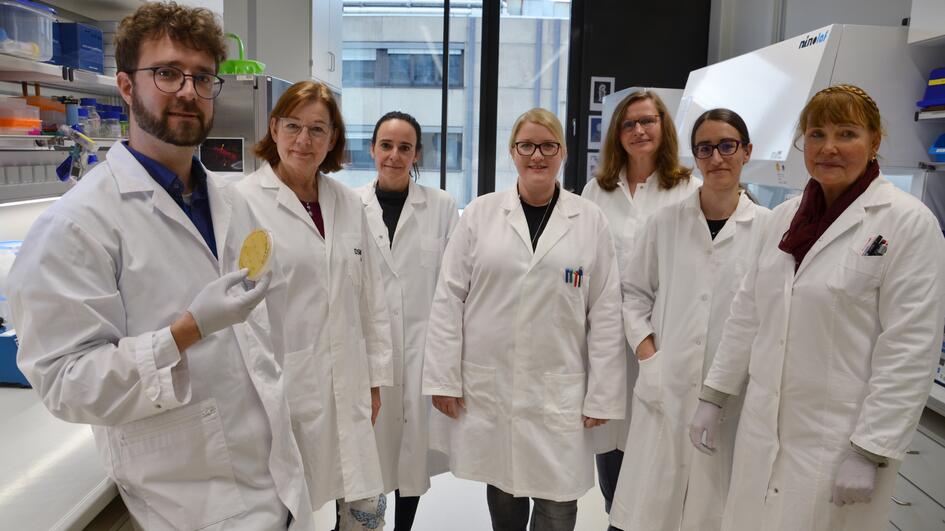
The "Phages" working group in a research laboratory of the Leibniz Institute DSMZ GmbH (from left to right): Johannes Wittmann, Christine Rohde, Filipa Martins, Anja Gatzemeier, Stephanie Peter, Clara Rolland and Bettina Henze. Johannes Wittmann, Christine Rohde, Filipa Martins, and Anja Gatzemeier are collaborating on a phage cocktail against the bacterium Enterococcus faecium in the DZIF EVREA-Phage project.
Antibiotic resistance is increasing at an alarming rate worldwide. New treatment options are urgently needed. Due to their specificity toward bacterial hosts, bacteriophages are a promising alternative or adjunct therapeutic option to conventional antibiotics. Their specificity and lack of adverse side effects make phages important objects in biomedicine research. Among the most critical bacterial pathogens in clinical settings are vancomycin-resistant enterococci (VRE), with Enterococcus faecium (VREfm) being of significance. Launched in July 2022, the EVREA-Phage project, aims to enable phage therapy for the reduction of intestinal VRE colonization, particularly in immunocompromised patients.
„With EVREA-Phage, we are laying the preclinical foundation for standardized, GMP-compliant phage therapy against vancomycin-resistant enterococci—an approach that is urgently needed in the face of increasing antibiotic resistance.“

Background
VREfm plays a significant role in clinical infections and remains listed on the ↗ WHO priority pathogens list (2024). This bacterium can rapidly proliferate in the intestine, especially in people with weakened immune systems. Typically, Enterococcus faecium is an inconspicuous member of the intestinal flora. However, under disbiotic conditions E. faecium may become dominant and if the intestinal mucosa is damaged, for example, during chemotherapy, the bacterium can enter the bloodstream and cause serious infections.
Treatment options are limited because many of these bacteria are resistant to common antibiotics. This is where bacteriophages come in. These are viruses that specifically infect and destroy bacteria. Unlike broad-spectrum antibiotics, bacteriophages attack only certain bacteria and largely spare the beneficial microorganisms in the intestine. The EVREA-Phage project is developing a carefully selected blend of four natural phages intended to be effective against as many clinically relevant VREfm strains as possible. The phage cocktail is designed to manage Enterococcus faecium in the intestine, either as a standalone therapy or as a supplement to the current standard treatment.
Development
In the EVREA-Phage project, four phages that specifically infect Enterococcus faecium were selected from a large collection due to their high efficacy against this bacterium.
The most promising phages are being further investigated in preclinical models, including a newly established artificial intestine model at University Hospital Bonn and a mouse model at the Helmholtz Centre for Infection Research in Braunschweig. The goal is to combine the most suitable phages into an effective cocktail that targets and eliminates as many clinically relevant Enterococcus faecium variants as possible.
Another central component of the project is defining the optimal conditions for applying the phages, such as dosage, frequency of administration, and duration of treatment. This information is essential for planning a clinical trial and requesting scientific guidance from the Federal Institute for Drugs and Medical Devices (BfArM). In the long term, a multicenter clinical trial involving interested DZIF partner sites is planned. In the future, this approach could be extended to include additional routes of administration and broader patient populations. This project creates a foundation that will benefit researchers, clinicians most importantly patients.


